HARA Software for ISO 12100 Risk Assessment
EnCo ASE guides hazard analysis and risk assessment (HARA) of machinery according to EN ISO 12100, from machine limits to risk reduction.
No obligation · Personal consultation · Fast response
Risk Assessment Workflow Based on ISO 12100
EnCo ASE HARA supports your team throughout the complete machinery risk assessment process, from the limits of the machinery and hazard identification to risk reduction and validation.
Determine
Limits
Determine the limits and intended use of the machinery
Identify
Hazards
Identify hazards and hazardous situations systematically
Estimate
Risk
Estimate risk with the systematic risk graph calculation
Evaluate
Risk
Evaluate whether risk reduction is required
Reduce
Risk
Define protective measures following the three step method
Iterate
Assessment
Repeat the assessment until risks are adequately reduced
Document &
Validate
Document results and support validation and compliance
EnCo ASE HARA guides you through the complete ISO 12100 methodology with integrated data, reuse of engineering knowledge and real time collaboration.
Read our White Paper: Risk Assessment in Machinery Engineering with EN ISO 12100
How machinery manufacturers use EnCo ASE and its HARA module to conduct structured, reusable risk assessments and risk reduction according to EN ISO 12100 and comply with the EU Machinery Regulation 2023/1230.
- The regulatory challenge: EN ISO 12100, its revision and the EU Machinery Regulation
- The EN ISO 12100 methodology in six steps, from the limits of the machinery to residual risks
- Legal compliance at the touch of a button: PLr and SIL for functional safety, audit-proof documentation, versioning
- Massive time savings: one database for safety and security analyses
PDF · 4 pages · English · free, no registration
Core HARA ISO 12100 Capabilities
From hazard identification and risk estimation to risk reduction and documentation, EnCo ASE provides the tools required to develop and maintain structured machinery risk assessments.
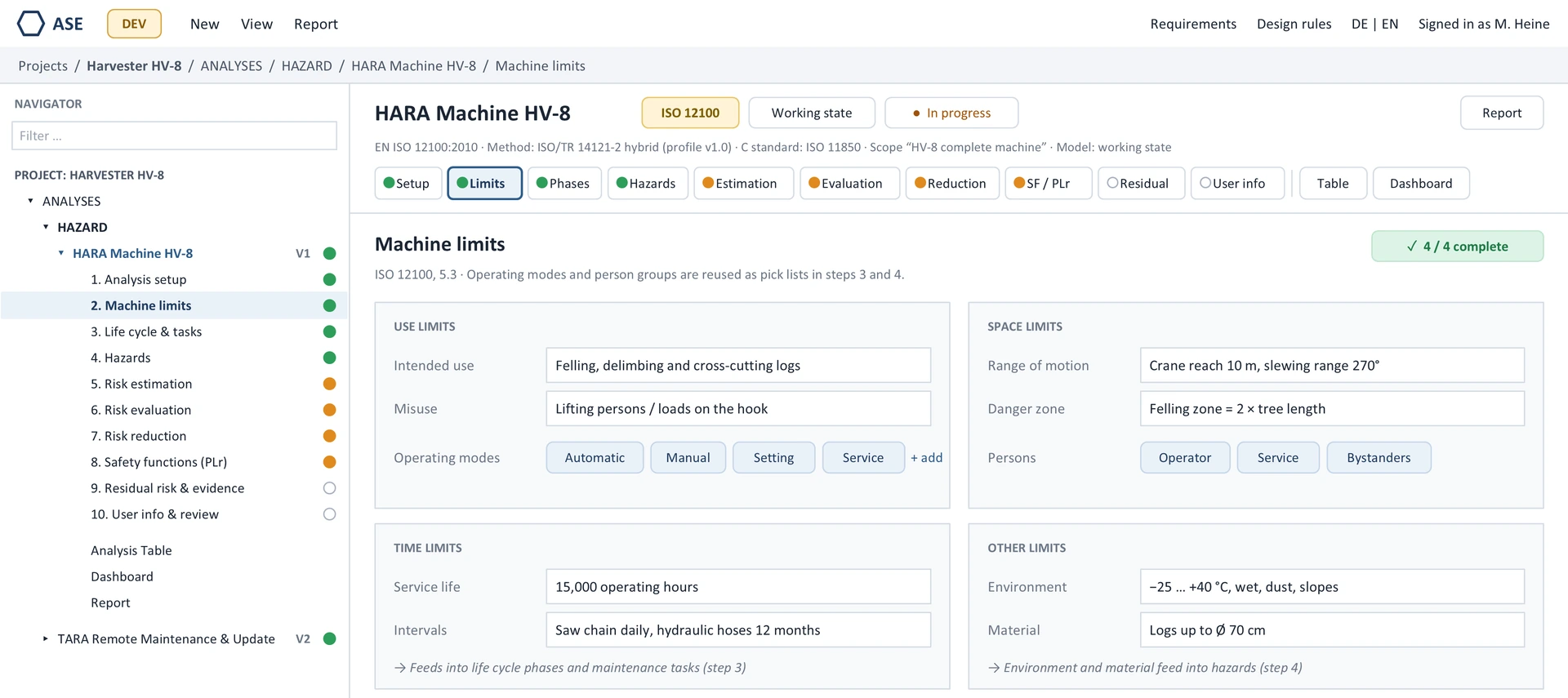
Machine Limits
Define the limits of the machine in four structured sections per ISO 12100, clause 5.3.
- Capture use, space, time and other limits
- Reuse operating modes and persons as pick lists
- See the completion status of each section
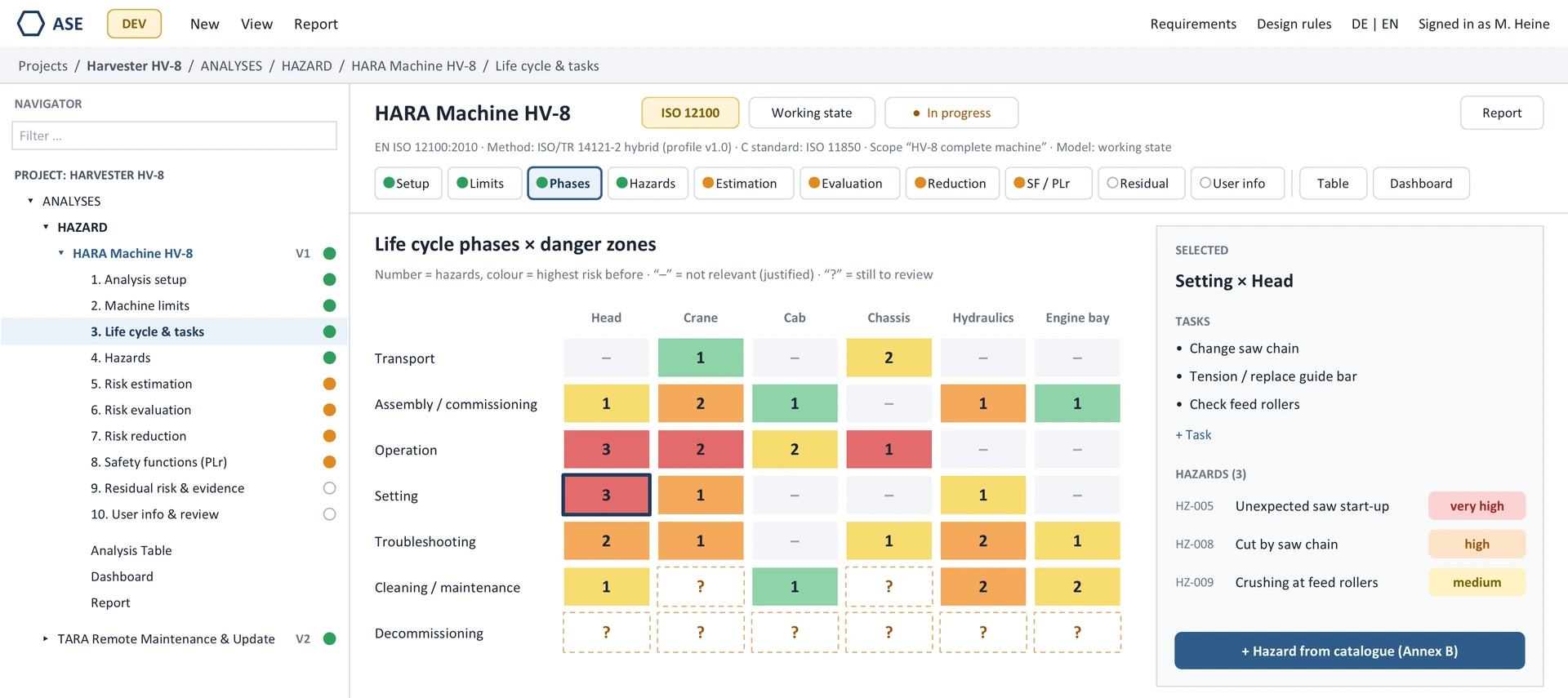
Life Cycle Phases × Danger Zones
Review every phase and zone in one matrix, making completeness visible and demonstrable.
- See hazard count and highest risk per cell
- Exclude irrelevant cells with a justification
- Keep open cells visible until reviewed
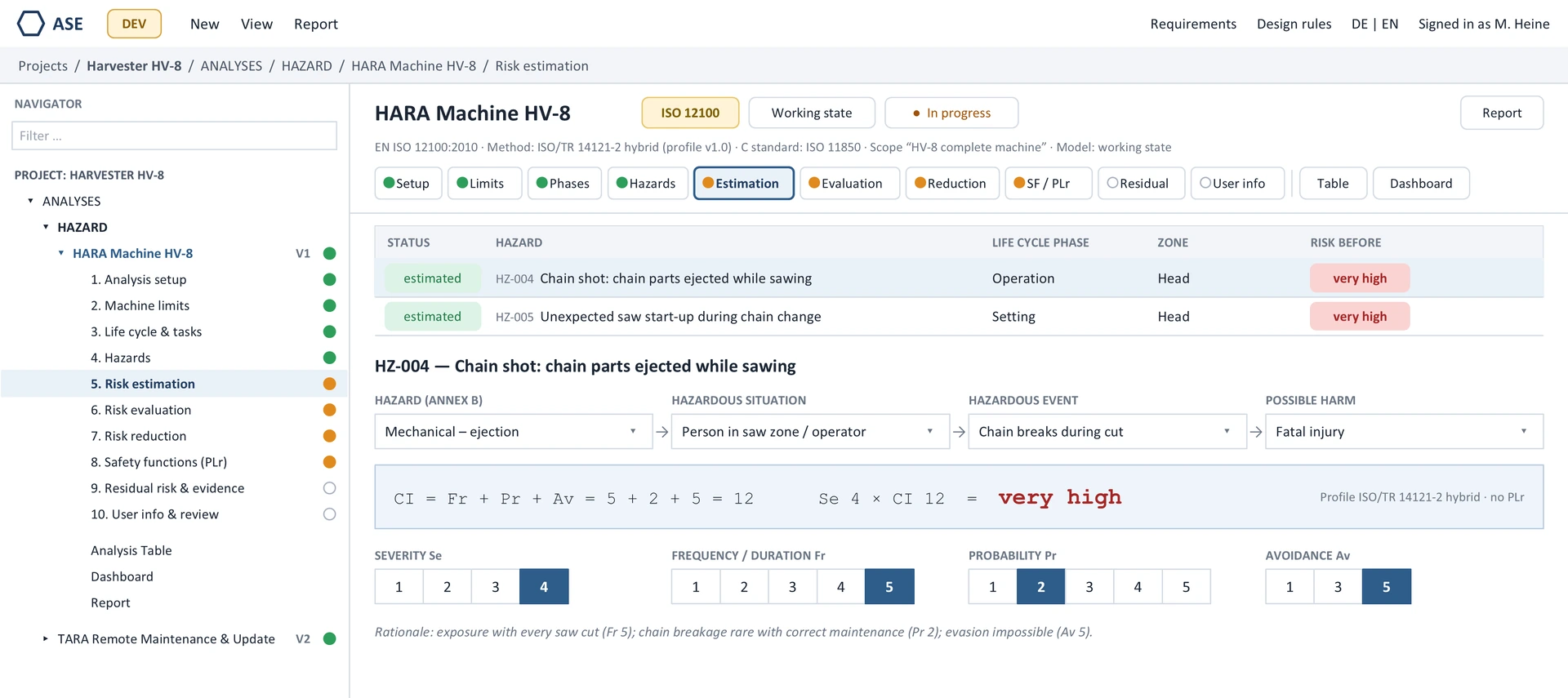
Hazards & Risk Estimation
Describe each hazard as an event chain and estimate its risk per ISO 12100, clause 5.5.
- Trace the chain from hazard to possible harm
- Rate severity, frequency, probability and avoidance
- Record the rationale for every estimate
Three-Step Risk Reduction
Record protective measures in the order of precedence of ISO 12100, clause 6.1.
- Inherently safe design, safeguarding, information for use
- Compare the risk before and after reduction
- Check for new hazards caused by measures
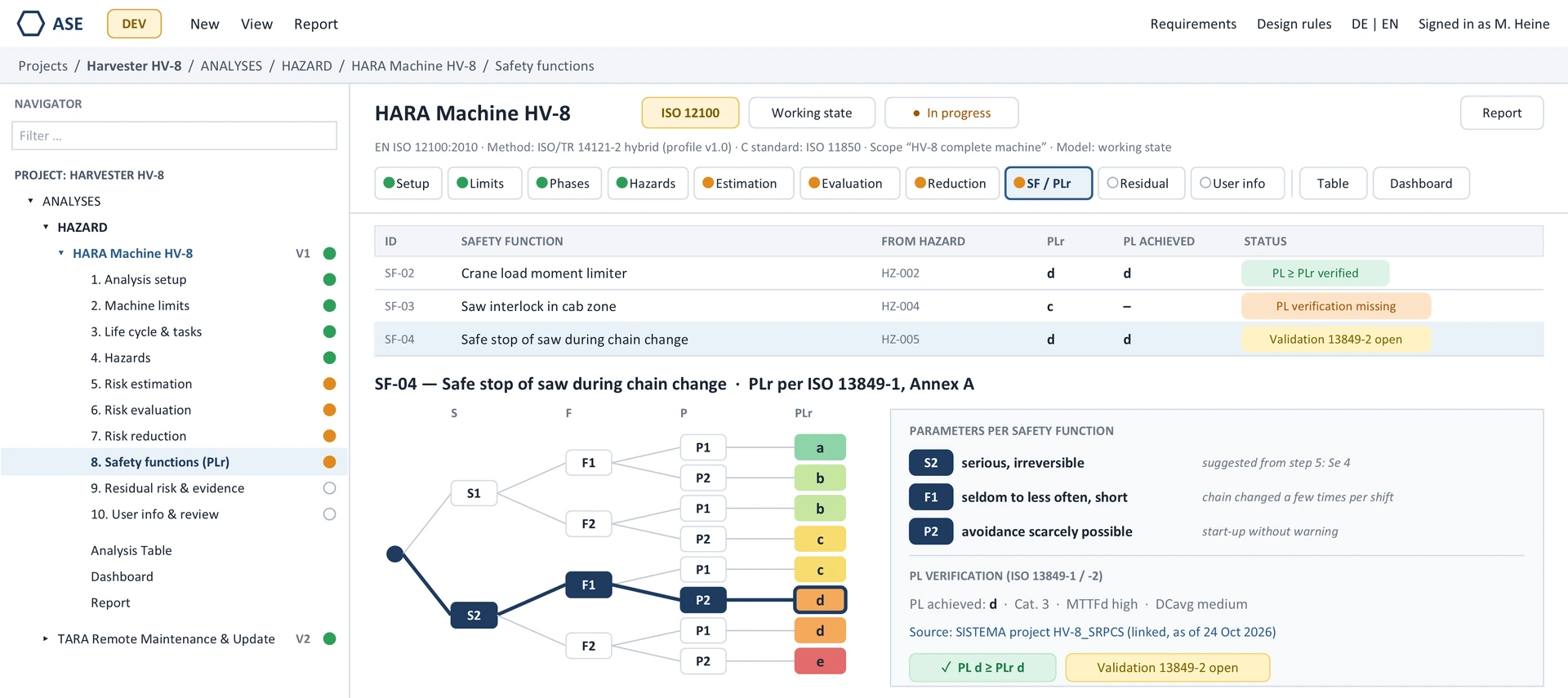
Safety Functions & ISO 13849-1
Determine the required performance level (PLr) of each safety function with the risk graph.
- Confirm suggested S, F and P values
- Link the PL verification, e.g. from SISTEMA
- Track the status of each safety function
All Hazards at a Glance
The Analysis Table shows every hazard of the assessment in one expert view.
- Filter by phase, zone, risk and status
- Compare risk before and after reduction
- See safety functions and PLr per hazard
Integrated Engineering. Connected Risk Assessment.
EnCo ASE connects the machinery risk assessment with requirements, system structures and additional safety analyses so engineering information can be reused, traced and maintained across the development process.
Requirements
Connect requirements and relevant engineering information directly with the assessment.
System Design
Reuse system structures, interfaces and engineering relationships within the analysis.
HARA ISO 12100
Develop structured machinery risk assessments using connected engineering data.
Protective Measures
Derive protective measures and manage them as requirements for implementation.
Safety Analyses
Connect results with further analyses such as FMEA and FTA.
Reporting
Use structured engineering data to create consistent reports and project documentation.
End to End Traceability
Maintain relationships between requirements, system elements, hazards, protective measures and downstream analyses.
Reuse Engineering Knowledge
Use existing information across analyses and projects instead of maintaining the same engineering knowledge multiple times.
Consistent Engineering Data
Work with connected data rather than isolated documents and reduce inconsistencies between engineering disciplines.
Risk assessment becomes part of the engineering model. EnCo ASE allows teams to connect analysis data across requirements, system design and safety engineering instead of managing the assessment as an isolated document.
Connect Your Risk Assessment with Your Engineering Toolchain
Import existing engineering information, exchange structured assessment data and export results for further use across your development environment. EnCo ASE helps integrate machinery risk assessment into established engineering workflows instead of creating another isolated data source.
Import
Bring existing engineering and analysis information into EnCo ASE and use available project data as the foundation for further analysis.
Data Exchange
Exchange structured engineering information between EnCo ASE and other systems while preserving relevant relationships within your workflow.
Export
Export assessment information and analysis results for documentation, communication and further use in your engineering environment.
Toolchain Integration
Connect assessment activities with surrounding engineering processes and keep information available where your teams need it.
Use Existing Data
Build on engineering information that already exists instead of recreating it manually inside the assessment.
Reduce Duplicate Work
Exchange and reuse structured information across engineering activities and reduce unnecessary manual data transfer.
Keep Engineering Connected
Integrate the risk assessment into the wider development process and maintain connections between relevant engineering information.
Your risk assessment does not have to live in isolation. EnCo ASE helps you move engineering information into, through and out of the assessment process while keeping it connected to your wider engineering environment.
Technical Overview
Key technical capabilities of EnCo ASE HARA ISO 12100 at a glance.
ISO 12100
Machinery Risk Assessment
Systematic
Risk Graph Calculation
Multi User
Web-Based Engineering
Catalogs &
Customizable Choice Lists
Requirements, System Design
& Safety Analyses
Import, Export &
Reporting
Ready to Improve Your Machinery Risk Assessment?
See how EnCo ASE HARA can support your engineering team with a structured ISO 12100 workflow, integrated engineering data and efficient knowledge reuse.
Frequently Asked Questions About HARA Software for ISO 12100
Find answers to common questions about EnCo ASE HARA, the ISO 12100 methodology, collaborative risk assessment and the integration into your engineering processes.
What is a risk assessment according to ISO 12100?
EN ISO 12100 is the basic standard for the safety of machinery. A risk assessment according to this standard means determining the limits of the machine, identifying hazards, estimating and evaluating the risks, and reducing them step by step until they are adequately reduced.
What is HARA software for ISO 12100?
HARA software for ISO 12100 supports engineering teams in performing machinery risk assessments in a structured way. Hazards, hazardous situations, risk estimation and risk reduction measures are managed in one consistent data model instead of spreadsheets.
Is HARA the same as a risk assessment according to ISO 12100?
HARA stands for hazard analysis and risk assessment. For machinery, ISO 12100 calls this task risk assessment, so both terms mean the same task on this page.
What is EnCo ASE HARA ISO 12100?
EnCo ASE HARA ISO 12100 is the machinery risk assessment module of the EnCo ASE engineering workbench. It combines the ISO 12100 methodology with multi user collaboration and direct integration into requirements, system design and further safety analyses.
Who is EnCo ASE HARA ISO 12100 for?
It is made for machine builders and their safety, design and compliance engineers who carry out risk assessments for CE marking.
Does the module follow the ISO 12100 process?
Yes. The assessment follows the ISO 12100 process of determining the limits of the machinery, identifying hazards, estimating and evaluating risk, and reducing risk iteratively until it is adequately reduced.
How is risk estimated?
Risk is estimated with a systematic risk graph calculation. Consistent criteria keep the estimation reproducible and comparable across hazards and machines.
How does ISO 12100 relate to ISO 13849-1?
ISO 12100 requires a protective measure where a risk is too high. If that measure relies on the control system, ISO 13849-1 defines the required performance level (PLr) and how the achieved PL is verified. EnCo ASE links each safety function to its hazard and determines the PLr with the risk graph of ISO 13849-1, Annex A. Read more in From ISO 12100 Risk Assessment to ISO 13849 Performance Level.
Does EnCo ASE support the EU Machinery Regulation 2023/1230?
The Machinery Regulation (EU) 2023/1230 applies from 20 January 2027 and also requires a risk assessment. EnCo ASE structures that assessment and keeps it traceable for the technical documentation. For the protection against corruption required by Annex III, safety functions can be carried over to EnCo ASE Threat Assessment.
Can multiple engineers work on an assessment at the same time?
Yes. Assessments are stored in a central database and support multi user collaboration, change history and review workflows, so distributed teams can work on the same assessment without exchanging files.
Can catalogs be reused across machines and projects?
Yes. Customizable choice lists and catalogs allow hazard and situation knowledge to be standardized and reused, so new assessments do not start from scratch.
How is documentation supported?
Assessment data can be documented with the integrated Report Designer and exported for compliance communication, so documentation stays consistent with the actual analysis data.
Why use dedicated software instead of Excel for ISO 12100?
Spreadsheets become hard to maintain as hazards, situations and measures grow and change. A database driven tool keeps relationships consistent, supports collaboration and versioning, and reduces manual effort when the assessment needs to be updated.
